







In this article
Precise and up-to-date asset tracking is important for the transport industry. For efficient fleet management, this information is crucial for managers. From deciding how to use assets most productively to handling periods of high demand, supervisors need to know exactly where their vehicles are so they can deploy them well. This industry has huge numbers of assets, and vehicles form the backbone of the transportation industry.
What is Transportation or Transport Sector?
The transportation sector is a category of companies that provide services to move people or goods, as well as the transportation infrastructure. Technically, transportation is a sub-group of the industrial sector according to the Global Industry Classification Standard (GICS).
The transportation sector consists of several industries, including air freight and logistics, airlines, marine, road and rail, and transportation infrastructure.
Also read: How RFID Asset Management Can Help in a Pandemic Environment?
How Can Asset Tracking Software Assist the Transport Industry?
Many organizations ship their products from one country to another, using ships, planes and other means of transportation. It is therefore important for organizations to keep track of their shipments.
That is why transportation asset management software is crucial. Asset tracking software for the transport industry helps in several ways.
Several technologies are used for asset tracking. Some of these are barcodes, QR (Quick Response) codes, RFID (radio-frequency identification) and NFC (near-field communication).
For transport industry activity, the best methods are GPS (Global Positioning System), IoT (Internet of Things) and BLE (Bluetooth Low Energy).
Transportation asset management software uses tags, which carry information about the asset or shipment. Let us discuss a few of the technologies.
IoT
IoT fleet management covers devices, the platforms that manage them and the networks that connect them, deployed in public, private or hybrid clouds.
It provides thorough tracking and the information that supervisors and managers are looking for. IoT is cost-effective and returns data in real time. With IoT sensors, users know where their assets are.
GPS
GPS is one of the best technologies for tracking vehicles. It works almost anywhere and offers accurate real-time tracking (see GPS.gov on GPS accuracy), which makes it especially useful for vehicles on the move.
GPS tracking became popular through fleet management. Today the technology is used in many other industries as well as the automobile sector.
What Are the Benefits of Asset Tracking Software for the Transport Industry?
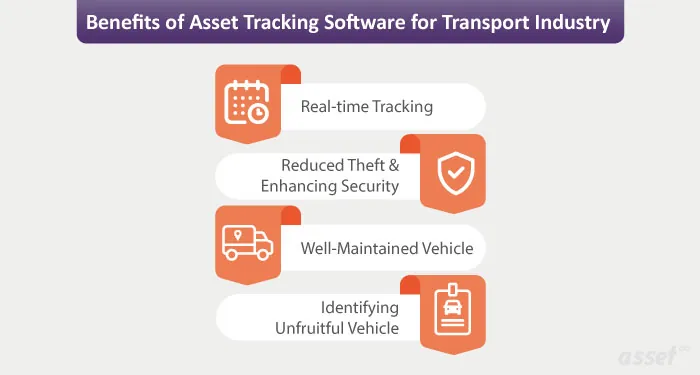
Some major benefits of asset tracking software for the transport industry are given below:
Also read: Benefits of BLE Based Student Tracking for Schools & Parents
Real-time Tracking
Old, manual methods of asset tracking waste time, especially in the transport industry. For example, if a fleet manager tracks devices, equipment and other assets in a spreadsheet saved on their own work PC, other team members cannot get to the information they need.
Spreadsheets are not a foolproof method for asset tracking. They are prone to errors from wrong data entry, which hurts the productivity of employees and the whole enterprise.
A cloud-based asset management system provides real-time information on each asset without compromising accuracy.
Reduced Theft & Enhancing Security
Theft is a widespread problem, and theft from the workplace is common too.
Asset theft affects the business in many ways. When equipment is lost or stolen, operations are affected immediately, productivity suffers and the bottom line takes a hit.
One of the simplest ways to protect your assets from theft is to tag them. Asset tracking software shows the location of each asset. A check-in and check-out feature shows which asset is assigned to which user. Together, these reduce the chances of theft and improve the security of assets.
Well-maintained Vehicle
Unplanned maintenance becomes a big hurdle when vehicles are not looked after properly and on time. Cab rental organizations, for example, run hundreds of vehicles. It is nearly impossible to keep track of them manually, and these vehicles need maintenance to stay in good running condition.
With fleet maintenance software, maintenance notifications and alerts are triggered on a regular schedule. This helps extend the lifespan of vehicles. When maintenance is done at regular intervals, vehicle efficiency improves and the risk of sudden breakdowns falls.
Identifying Unfruitful Vehicle
It is crucial to identify unproductive vehicles, or ones that are not in use but still cost money to maintain. These vehicles drag down the organization’s productivity.
Asset software can monitor and project the depreciation of items so they can be replaced when the time comes. By identifying unproductive items, the system supports decision-making and helps the business grow.
Also read: Urban Ambulance Fleet Management
Transport Assets Need Tracking, Maintenance and Security
The transport industry is a huge sector, and it is connected with many other industries. Its modes include air, water, road and rail. Transportation lets manufacturers send their goods and shipments, carries passengers in cab services, and much more. Transport assets are at the core of businesses around the world.
Transport assets need maintenance and security, and transportation asset management software makes both possible. It keeps the organization from buying assets or vehicles too early and provides important information such as asset location and current user.
The software lets you monitor assets and vehicles at any time, from anywhere. You can also see the maintenance history of each vehicle.
This software brings many benefits. If you need more information or help, you can always contact us. We will be happy to help.