
.webp)
.webp)
.webp)
.webp)



.webp)


Managing assets across multiple business locations has become significantly more complex in recent years. As enterprises expand geographically, often operating across 10, 20, or even 50+ locations, the challenge of maintaining visibility, control, and accountability over assets increases exponentially. In 2026, asset tracking is no longer a “nice to have” capability for distributed enterprises; it is a foundational requirement for operational efficiency, compliance, and cost control.
Traditional spreadsheets, manual audits, and disconnected tools simply cannot keep up with modern, fast moving organizations. Enterprises today require centralized visibility, real time data, and scalable systems that allow them to track assets seamlessly across regions, facilities, and teams. This is where a modern asset tracking system plays a critical role, helping organizations unify asset data, reduce losses, and make informed decisions at scale.
In this blog, we explore how distributed enterprises can implement effective asset tracking strategies across 10+ locations in 2026, the challenges they face, and the technologies that make enterprise wide asset visibility possible.
The Reality of Asset Management in Distributed Enterprises
Distributed enterprises operate in an environment where assets are constantly on the move. Equipment is transferred between sites, IT assets are reassigned to employees, tools rotate across projects, and vehicles move across regions daily. Without a centralized asset management tracking approach, these movements create blind spots that lead to inefficiencies, compliance risks, and financial leakage.
Some of the most common realities faced by multi location enterprises include:
- Limited visibility into asset location and condition
- Inconsistent asset records across departments
- Difficulty tracking asset movement between sites
- Delayed audits and reconciliation processes
- Higher risk of asset loss, theft, or underutilization
As the number of locations increases, these issues multiply. Enterprises with 10+ sites often discover that asset data exists in silos, making it difficult to answer basic questions such as:
- Where is this asset right now?
- Who is using it?
- Is it under warranty or due for maintenance?
A centralized asset tracking solution becomes essential to overcome these operational challenges.
Why Traditional Asset Tracking Methods Fail at Scale
Many enterprises begin their asset journey with spreadsheets or basic tools. While this may work for a single location, these methods quickly collapse under the complexity of distributed operations.
1. Lack of Real Time Visibility
Manual methods offer static data that becomes outdated the moment assets move. Without real time updates, teams cannot rely on the information they see.
2. High Dependency on Manual Processes
Manual data entry increases the risk of errors, duplication, and missed updates—especially when multiple teams across locations are involved.
3. Poor Accountability
When asset ownership and movement are not digitally tracked, accountability becomes unclear, increasing the likelihood of asset misuse or loss.
4. Audit and Compliance Challenges
Enterprises operating across regions must comply with internal policies and external regulations. Without a robust asset tracking system, audits become time consuming and error prone.
The Role of Asset Tracking in Multi Location Operations
Modern asset tracking enables enterprises to maintain a single source of truth for all physical and digital assets regardless of where they are located. By centralizing asset data, organizations gain full lifecycle visibility from procurement to disposal.
A scalable asset tracking system allows enterprises to:
- Monitor asset movement between locations
- Track asset usage and performance
- Assign ownership and responsibility
- Automate audits and compliance checks
- Improve asset utilization across regions
Rather than managing assets in isolation, enterprises can view their entire asset landscape through a unified platform, enabling better planning and faster decision making.
Key Challenges of Tracking Assets Across 10+ Locations
1. Asset Mobility
Assets frequently move between warehouses, offices, factories, and job sites. Tracking these movements manually is inefficient and unreliable.
2. Data Fragmentation
Different locations often maintain their own asset records, leading to duplication and inconsistencies.
3. Operational Silos
When departments or regions operate independently, asset data becomes fragmented, reducing enterprise wide visibility.
4. Scalability Constraints
As enterprises grow, tracking methods that worked for 2-3 locations fail to scale across larger networks.
An enterprise grade asset tracking solution addresses these challenges by standardizing processes and providing centralized control.
How Modern Asset Tracking Systems Work Across Locations
A modern asset tracking system is designed to support distributed environments by offering centralized dashboards, role based access, and location based asset views. These systems integrate seamlessly with enterprise workflows, ensuring asset data remains accurate and accessible.
Key capabilities include:
- Centralized asset repository
- Location based asset assignment
- Movement history and audit trails
- Integration with ERP and IT systems
- Mobile access for on site updates
With cloud based deployment, teams across all locations can access the same asset data in real time—eliminating silos and improving collaboration.
Traditional vs Modern Asset Tracking
Technologies Powering Enterprise Asset Tracking in 2026
Modern enterprises leverage multiple technologies to enable accurate and scalable asset management tracking across locations.
1. RFID and IoT
An asset tracking system RFID setup allows enterprises to automatically identify and track assets without manual scanning. RFID tags provide real time updates on asset movement, making them ideal for high volume environments.
2. GPS Tracking
For mobile assets such as vehicles or outdoor equipment, GPS enables real time location tracking across geographies.
3. Barcodes and QR Codes
Cost effective and easy to deploy, barcode based equipment tracking solutions remain widely used for indoor and controlled environments.
4. Cloud Based Platforms
Cloud deployment ensures scalability, data security, and accessibility for distributed teams.
Industry Examples of Distributed Asset Tracking
Enterprises across industries rely on equipment tracking solutions to maintain control over assets spread across locations:
- Manufacturing: Tracking machines, tools, and spare parts across plants
- Logistics: Monitoring vehicles, containers, and handling equipment
- Healthcare: Managing medical devices across hospitals and clinics
- IT Services: Tracking laptops, servers, and network equipment across offices
In each case, a centralized asset tracking solution ensures consistency, compliance, and operational efficiency.
Key Features Distributed Enterprises Need in an Asset Tracking System
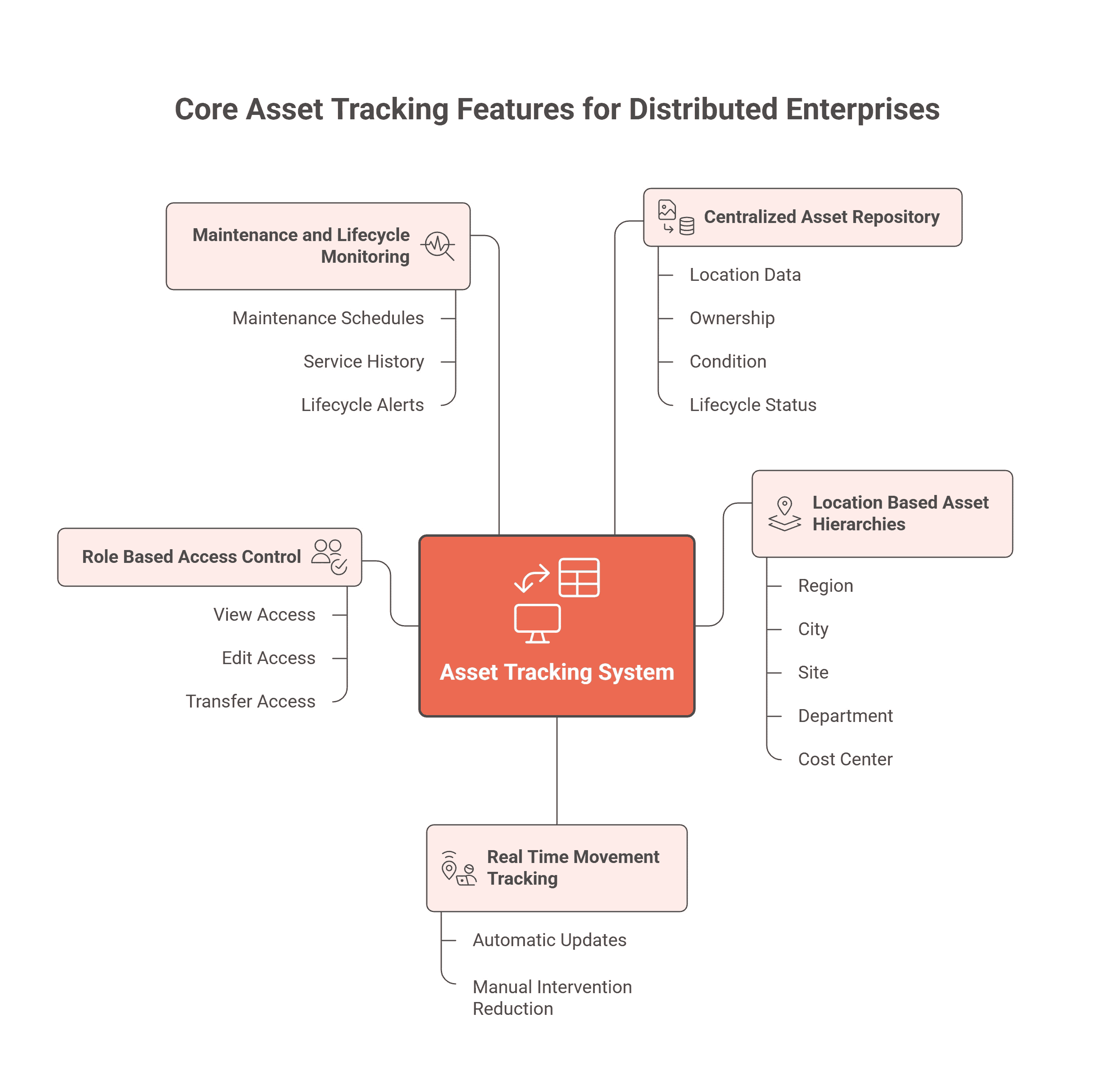
As enterprises scale beyond 10 locations, asset visibility alone is not enough. A modern asset tracking system must be built to handle complexity, scale, and governance. In 2026, enterprises should prioritize systems that support centralized control while enabling localized operations.
1. Centralized Asset Repository
A single, unified repository ensures that all asset data such as location, ownership, condition, and lifecycle status is stored in one place. This eliminates duplication and ensures consistency across regions.
2. Location Based Asset Hierarchies
Enterprises must be able to categorize assets by region, city, site, department, or cost center. This structured asset management tracking approach allows leaders to quickly assess asset distribution and utilization.
3. Real Time Movement Tracking
An enterprise ready asset tracking solution should capture asset movement between locations automatically, ensuring location data remains accurate without manual intervention.
4. Role Based Access Control
Different teams require different levels of access. A robust asset tracking system allows enterprises to control who can view, edit, or transfer assets across locations.
5. Maintenance and Lifecycle Monitoring
Tracking assets is not just about location; it’s about condition and performance. Modern equipment tracking solutions include maintenance schedules, service history, and lifecycle alerts to extend asset lifespan.
Enterprise Asset Tracking Feature Checklist
Choosing the Right Asset Tracking Solution in 2026
With many platforms available, selecting the right asset tracking solution requires a strategic evaluation aligned with enterprise needs.
1. Scalability First
The system must handle growth of more assets, more users, and more locations without performance issues. A scalable asset tracking system supports expansion without requiring major reconfiguration.
2. Integration Capabilities
Enterprises rely on ERP, ITSM, procurement, and finance tools. Seamless integration ensures asset data flows across systems, improving decision making.
3. Automation and Intelligence
Automation reduces manual effort. From auto updating asset movement to predictive maintenance alerts, intelligent asset management tracking enhances efficiency.
4. Support for Multiple Tracking Technologies
A flexible system should support barcodes, GPS, and asset tracking system RFID configurations allowing enterprises to choose the best technology for different asset types.
RFID Based Asset Tracking for Large Enterprises
RFID continues to play a significant role in enterprise asset strategies. An asset tracking system RFID setup enables automatic asset identification without line of sight scanning, making it ideal for high density environments.
RFID based tracking is particularly effective for:
- Warehouses with high asset turnover
- Manufacturing plants with shared equipment
- Hospitals managing mobile medical devices
When integrated into a centralized asset tracking system, RFID enables faster audits, reduced losses, and improved operational accuracy.
Business Impact of Asset Tracking Across Multiple Locations
A well implemented asset tracking solution delivers measurable business value across the enterprise.
1. Improved Asset Utilization
By identifying underutilized assets across locations, enterprises can redeploy resources instead of purchasing new ones.
2. Reduced Asset Loss and Theft
Real time tracking and accountability significantly reduce asset misplacement and shrinkage.
3. Faster Audits and Compliance
With automated records and movement logs, audits that once took weeks can be completed in hours.
4. Lower Operational Costs
Effective equipment tracking solutions reduce downtime, maintenance costs, and unnecessary capital expenditure.

Industry Specific Benefits of Asset Management Tracking
1. Manufacturing
Factories operating across regions rely on asset management tracking to monitor machinery, tools, and spare parts, ensuring production continuity.
2. Logistics & Transportation
Fleet operators use asset tracking systems to monitor vehicles, containers, and handling equipment across routes and hubs.
3. Healthcare
Hospitals depend on equipment tracking solutions to locate critical devices quickly, improving patient care and compliance.
4. IT & Corporate Enterprises
Distributed offices use centralized asset tracking to manage laptops, servers, and network devices efficiently.
Preparing for the Future of Asset Tracking in 2026
As enterprises become more distributed, asset visibility will directly impact competitiveness. In 2026, organizations that invest in scalable, intelligent asset tracking systems will gain a strategic advantage through better control, reduced costs, and faster decision making.
Emerging trends such as AI driven insights, predictive maintenance, and deeper IoT integration will further enhance enterprise asset tracking systems, transforming them from operational tools into strategic assets.
Conclusion
Managing assets across 10+ locations is one of the most complex challenges faced by modern enterprises. Without a centralized and scalable approach, asset data becomes fragmented, visibility is lost, and costs rise. A future ready asset tracking solution empowers organizations to overcome these challenges by delivering real time visibility, accountability, and lifecycle control across all locations.
By adopting a robust asset tracking system that supports automation, RFID, and enterprise integrations, distributed businesses can transform asset management from a reactive task into a strategic capability positioning themselves for operational excellence well beyond 2026.
FAQs: Asset Tracking for Distributed Enterprises
What is the best way to track assets across multiple locations?
The most effective approach is using a centralized asset tracking system that supports location hierarchies, real time updates, and automated movement tracking.
Is RFID suitable for large enterprises?
Yes. An asset tracking system RFID setup is ideal for enterprises with high asset volumes, frequent movement, and minimal tolerance for manual errors.
Can one system track different asset types?
Modern asset tracking solutions support multiple asset categories, from IT equipment to heavy machinery, within a single platform.
How does asset tracking improve audits?
By maintaining accurate records, movement history, and ownership logs, asset management tracking significantly simplifies audits and compliance reporting.








.png)

