







In this article
Getting precise information about assets is one of a fleet manager’s most important jobs. Another huge task is knowing which asset is needed at which location so that no work is held up.
Fleet managers must know where their vehicles, equipment and other assets are in order to use them properly.
An asset tracking system provides the information that asset and fleet managers need.
What Is an Asset Tracking System?
Asset tracking is a process for tracking and monitoring a company’s fixed or movable assets for financial accounting, preventive maintenance and theft deterrence.
It lets you track your assets’ movement. Assets include costly items such as laptops, computers, vehicles and other equipment, or anything important to a business. An asset tracking system provides information such as asset status and location.
Asset tracking software benefits are delivered through RFID tags, GPS and QR codes. The software’s main purposes are to improve asset usage, keep valuable items secure and schedule maintenance.
The main objective of asset tracking software is to increase asset control and reduce equipment loss in your organization. It provides features that save you money and time, such as asset management, inventory management and scheduled maintenance.
Asset tracking is crucial to your organization’s growth and compliance.
What Are the Techniques Used for Asset Tracking?
Several techniques can be used for asset tracking:
- Barcode Label: Your valuable items can be tracked with barcode technology. The barcode tag is scanned with a barcode scanner or a phone. Barcode labeling is very cost-effective.
- RFID (Radio Frequency Identification): RFID is also used for asset tracking. It can be short range or long range depending on your business requirements, and RFID tags can be active or passive. With RFID tags, a person can read many assets within a few seconds.
- GPS (Global Positioning System): Assets can be tracked almost anywhere with devices that combine GPS with a cellular connection. These devices are called GPS asset trackers, and they usually have a battery or draw power from the vehicle. On vehicles, a tracker can also report trips and odometer readings.
- NFC (Near Field Communication): NFC is a newer option for asset tracking. A tap with a phone brings up all the information about the asset.
How Does an Asset Tracking System Help Fleet Managers?
An asset tracking system offers fleet managers many benefits. Here are six of them:
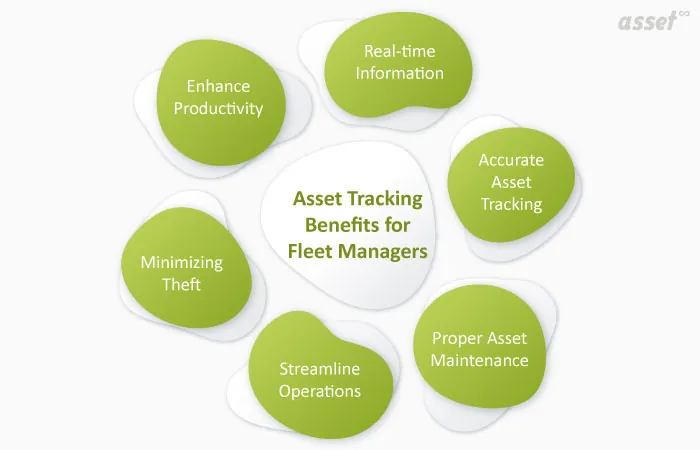
1. Real-Time Information
Old, traditional methods for asset tracking can waste a lot of time, especially for fleet managers.
For instance, if a fleet manager tracks devices, equipment and assets in a spreadsheet saved on a work PC, other team members cannot get the information they need.
The spreadsheet method is far from foolproof and is prone to errors. That affects the productivity of each employee and of the organization.
A cloud-based asset management system provides current information on each asset without compromising accuracy. When several people need the same information, a shared system keeps everyone working from the same, current record.
2. Accurate Asset Tracking
Tracking assets is no simple job, particularly if your business has multiple branches in different areas. Assets come in all sizes, from small to very large. An asset tracking system lets you track all of them.
For example, if you have several delivery vehicles, you can keep track of each one. You can see whether a vehicle is parked or in use and what its current status is.
The tracking software gives you accurate, exact information. It is also a good way of tracking depreciation and the value of every asset.
The software also plays an important role in maintenance, keeping assets in good, efficient condition and improving their performance.
Also read: What Are the Requirements of the Asset Management System?
3. Proper Asset Maintenance
Maintenance needs to happen regularly. If you wait for a machine to deteriorate, it will cost you money and time, and your work and productivity will suffer.
It is better to avoid that scenario. Maintaining assets is a crucial practice, yet many organizations neglect it, with serious consequences.
One of the most important benefits of asset tracking software for fleet managers is that planned maintenance keeps assets lasting longer and performing better.
Best of all, you don’t have to track it manually. Asset tracking software does it for you and reminds you of upcoming equipment maintenance.
4. Simpler Operations
Asset tracking software improves your daily activities and operations. It removes unnecessary steps from daily work, making it more efficient and faster. Drivers and technicians spend less time on paperwork, and managers spend less time chasing updates.
Simpler daily operations strengthen your professional reputation and increase business productivity.
5. Minimizing Theft
Proper asset management can save thousands of dollars. Asset theft and misplacement happen in every industry.
Construction sites, for example, often have little or no security. That increases the chance of employee theft, and it means anybody can enter the site and steal assets such as tools, equipment and vehicles.
Equipment theft hurts the business in many ways. When equipment is lost or stolen, daily operations are disrupted and projects are not completed on time. That directly affects the company’s productivity and bottom line. Knowing exactly which equipment is on each site, and who signed it out, makes it much easier to notice when something goes missing.
6. Enhance Productivity
Many organizations notice recurring issues and still take no action, and productivity drops.
An asset tracking system gives full visibility and control of maintenance activities, so fleet managers can see how many tasks are completed and how many remain.
It ranks tasks by priority and organizes them so that none is neglected. It also improves work efficiency.
It helps plan tasks and record work so the team can finish jobs sooner. With proper tracking and planning, output and productivity rise and the team’s stress falls.
Also read: How Crucial Is It to Include Real-Time Asset Tracking System?
Getting More from Fleet Asset Tracking
These are only a few of the benefits of using an asset tracking system. Fleet managers can also tailor fleet maintenance software to their specific requirements, because every organization works differently.
The software can be set up for your company’s specific needs. Contact us or book a demo, and we will be happy to help.