


In this article
- What Is Fixed Asset Accounting Software?
- What Fixed Asset Accounting Software Must Do
- A Depreciation Method Chooser
- Book and Tax Side by Side: A Worked Example
- Four Kinds of Fixed Asset Accounting Software
- How Fixed Asset Accounting Works in Asset Infinity
- What It Costs in Asset Infinity
- Frequently Asked Questions
Fixed asset accounting software keeps the depreciation, carrying amount and history of every capitalized asset, runs each period’s depreciation in every book you keep, and sends the journals to your general ledger. Good tools also tie each line of the register to a physical asset, so the figures on the balance sheet can be counted.
That last part is where most fixed asset accounting goes wrong: a spreadsheet will happily depreciate a machine that was scrapped two years ago. This guide covers what the software has to do, a chooser for the depreciation methods you will meet, a worked book-and-tax example, and the four kinds of tool finance teams pick between.
What Is Fixed Asset Accounting Software?
Fixed asset accounting software is a subledger for long-term assets. It records what each asset cost and when it went into service, depreciates it under the rules of each accounting book, closes periods, and produces the journal entries that the general ledger posts. It also records disposals, revaluations and impairments, with the gain or loss each one creates.
Teams usually buy it at one of three moments. The asset count outgrows a spreadsheet that one person understands. The company starts keeping a tax book that disagrees with the statutory book. Or an audit finds that the register and the floor do not match, and nobody can say which is right.
What Fixed Asset Accounting Software Must Do
The table below is the checklist. The last column is the question that separates a real subledger from a list with a depreciation formula attached.
| Capability | Why it matters | What to ask the vendor |
|---|---|---|
| Several books per asset | Book and tax depreciation disagree every month, and IFRS or management books add more | Can one asset sit in a GAAP book and a tax book at once, with different methods? |
| Methods and conventions | Straight-line, declining balance, units of production, and published tables such as MACRS, with half-year and mid-quarter conventions | Are the MACRS tables built in, and who updates them? |
| Capitalization from projects | Plant built over months collects cost before it can depreciate | Can construction cost be held aside, then capitalized into one or more assets? |
| Period close | A month that is calculated but not posted is a month nobody charged | Is there a draft, a post that closes the period, and a reversal that keeps the original? |
| Journals to the ledger | The general ledger posts summarized lines: one debit and one credit per account for each run | Does it map books to ledger accounts and export or send the batch? |
| Disposals | Sales, scrapping and partial disposals each create a gain or loss in every book | Is a disposal recorded once and calculated in every book? |
| Revaluation and impairment | IFRS books may carry assets at fair value and must test for impairment | Does it keep a revaluation reserve and record what an impairment wrote the asset down to? |
| Opening balances | You are not starting from zero | Can I load cost and accumulated depreciation per asset per book from my old system? |
| A link to the physical asset | Ghost assets keep depreciating and keep being taxed | Does the register know where each asset is, and flag one that has left but is still on the books? |
| An audit trail | Auditors ask who changed a life or a method, and when | Is every run, reversal and change kept with a name and a date? |
Under IAS 16, a company may carry a class of assets at revalued amounts, so a tool sold to IFRS reporters needs the revaluation reserve. US GAAP companies rarely revalue, but they still need impairment and disposal accounting.
A Depreciation Method Chooser
Most fixed asset accounting comes down to six methods. This is the reference to keep beside your asset classes.
| Method | How the charge is worked out | Typical use | Book or tax |
|---|---|---|---|
| Straight-line | Cost less salvage value, spread evenly over the useful life | Buildings, furniture, most equipment in the financial statements | Book (GAAP and IFRS); also MACRS for real property |
| Declining balance (150% or 200%) | A fixed rate on the remaining carrying amount, usually switching to straight-line when that gives more | Assets that lose value early: vehicles, computers | Book where it fits the pattern of use; the basis of MACRS |
| MACRS GDS | Published percentages per year by property class (3, 5, 7, 15, 20 years…), with a half-year or mid-quarter convention | US federal tax return | Tax |
| MACRS ADS | Straight-line over longer, published recovery periods | Property that must use ADS, and some elections | Tax |
| Units of production | Cost spread by the work the asset does (hours, miles, cycles) | Machines and vehicles whose wear follows use | Book |
| Immediate expensing | The whole cost in the first year, under an election or a capitalization threshold | Low-cost items and qualifying equipment | Tax, and book below the threshold |
Two rules from IRS Publication 946 catch people out. MACRS uses the half-year convention by default, but if more than 40% of the year’s depreciable property goes into service in the last three months, the mid-quarter convention applies to all of it. And residential rental property and nonresidential real property use straight-line over 27.5 and 39 years, never a declining balance.
To see the MACRS numbers for an asset, use our free MACRS depreciation calculator.
Book and Tax Side by Side: A Worked Example
A plant buys a CNC lathe for $60,000 and puts it into service in March. The statutory book depreciates it straight-line over 10 years from the month it went into service, with no salvage value. The tax book treats it as 7-year MACRS property with the half-year convention.
| Year | Book: 10-year straight-line | Tax: 7-year MACRS | Difference |
|---|---|---|---|
| 1 | $5,000 (10 months) | $8,574 (14.29%) | $3,574 |
| 2 | $6,000 | $14,694 (24.49%) | $8,694 |
| 3 | $6,000 | $10,494 (17.49%) | $4,494 |
| After 3 years | $17,000 | $33,762 | $16,762 |
Both figures are right, in their own book. The difference is a temporary difference your accountant tracks for deferred tax. This is why “one depreciation column” in a spreadsheet stops working the moment a tax book exists. Each book needs its own schedule, its own accumulated figure and its own journal, from the same asset record. Our guide to accumulated depreciation shows where each figure lands on the balance sheet.
Four Kinds of Fixed Asset Accounting Software
Finance teams usually choose between four kinds of tool. Each fits a different organization.
Fixed asset modules in accounting suites
Xero, Sage Intacct, NetSuite and Microsoft Dynamics 365 Business Central all offer a fixed asset register inside the ledger. The fit is good when the register is modest and finance owns it alone, because there is nothing to integrate. Check how each handles a second book and published tax tables. Nobody outside finance will scan an asset in the general ledger, so physical verification happens somewhere else.
Dedicated fixed asset tax and accounting tools
Sage Fixed Assets and Bloomberg Tax Fixed Assets are built around depreciation, tax books and tax reporting. They suit companies with large, tax-sensitive registers and a tax team that works in them every day. Their strength is the books. Ask how physical counts and custody are handled, because maintenance and day-to-day custody of the assets sit outside them.
Spreadsheets
A spreadsheet is free and immediate, and for under about 100 assets in one place with one book it can be enough. It breaks on a second book, on several people editing, and on history: a changed formula leaves no trace. Our fixed asset register guide shows what a spreadsheet register needs to hold if you stay on one.
Asset platforms with a depreciation subledger
Asset Infinity and similar platforms keep the books on the same record that operations uses to tag, count, move and maintain the asset. The fit is strongest when the register is large or spread over sites, when physical verification is an audit finding, or when capital projects and maintenance costs should reach finance without re-keying.
How Fixed Asset Accounting Works in Asset Infinity
In Asset Infinity, depreciation is a subledger that sits on the asset register. The same asset that a technician scans on the floor carries its carrying amount in every book. A month runs like this:
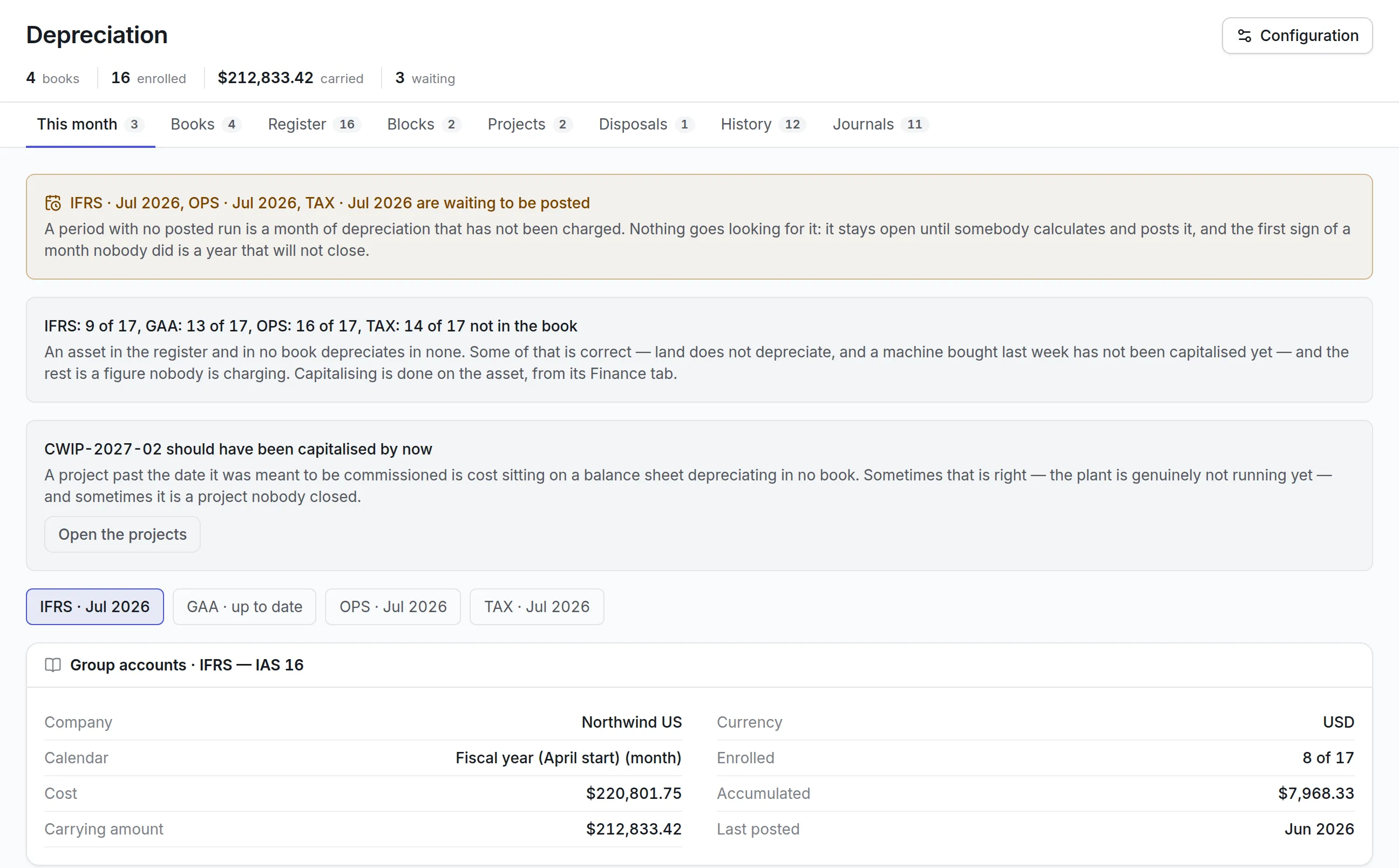
- Set up the books once. Add a book for each set of answers you keep (statutory, tax, IFRS, management or insurance), each with its company, currency and fiscal calendar. Install the MACRS tables and write policies: a method, a life or rate, a residual, and a first-period convention such as half-year or mid-quarter.
- Capitalize. An asset enters a book from its Finance tab, or a capital project that collected construction costs is capitalized into one or more assets, with the amounts adding up exactly to what the project spent.
- Calculate the period into a draft. Nothing is charged yet. The draft lists every asset charged and every one that was not, with the reason: not in service yet, already written down to its residual, no meter reading for a units-of-production asset.
- Post and close. Posting charges the period and closes it, with an approval first if you configure one. A mistake is reversed with an opposite entry, and both runs stay in the history.
- Hand the journal to the ledger. Posting rules map each book to your ledger accounts. The batch is sent through a connector or downloaded for you to load.
- Record what leaves. A disposal is recorded once, with the buyer, the invoice and the price, and the gain or loss is calculated in every book. Partial disposals and write-offs work the same way.
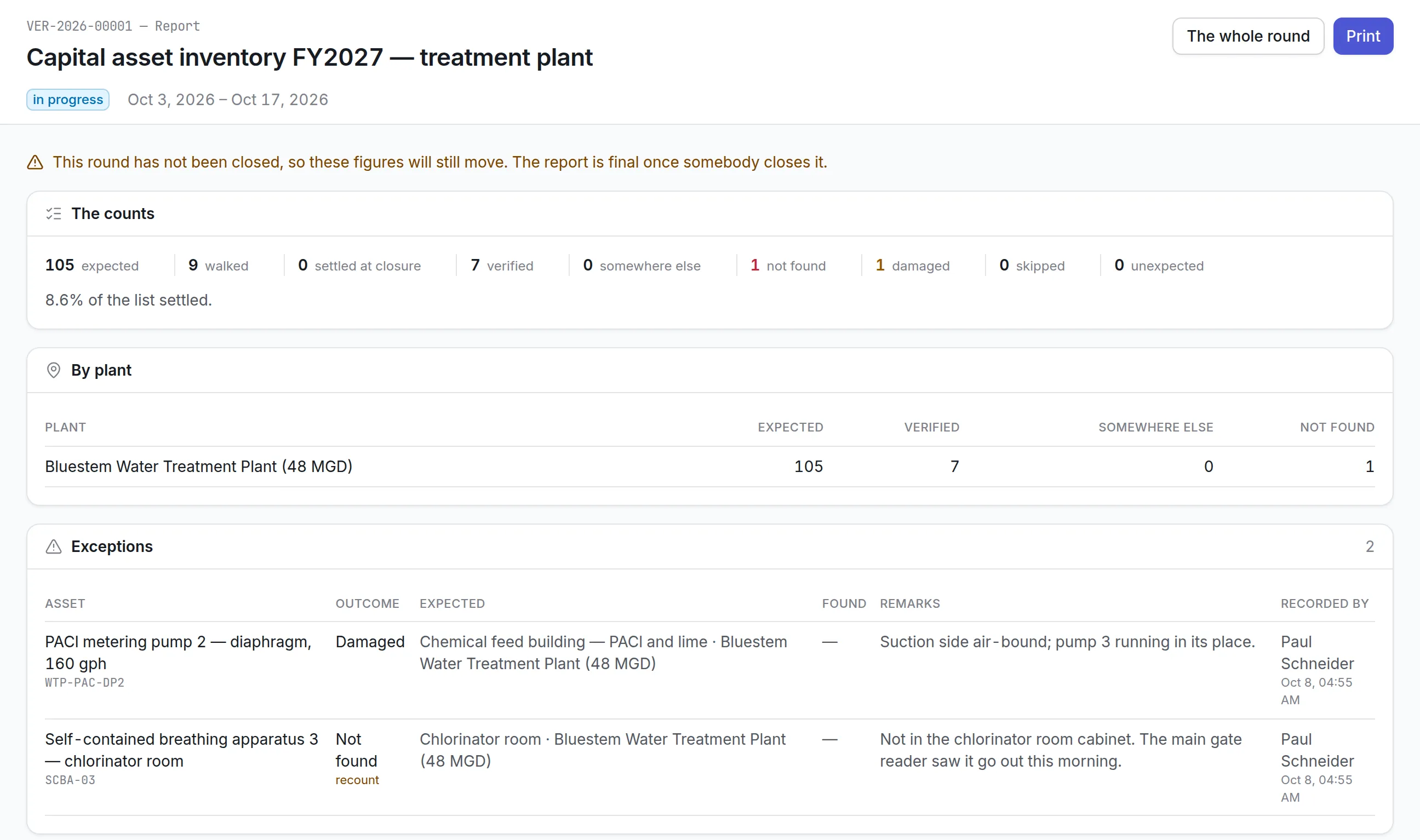
The screen also reconciles. It flags periods nobody has posted, assets on the register that are in no book, and assets whose status says they have left while the books still charge them. Pair that with phone-based physical verification, and the count and the books agree before the auditor asks.
Units-of-production depreciation reads the same meters that maintenance already reads, so running hours drive both the next service and the month’s charge. A capital project can be funded from an approved budget, and the yearly capex round that produces those budgets runs in capital planning.
What It Costs in Asset Infinity
The asset register starts at $130 a month for up to 500 assets, with unlimited users. Depreciation books are part of the Finance bundle, at $30 a month for each user who runs them. You can build a quote for your asset count, or see the full fixed asset management software page for everything finance gets on the platform.
Frequently Asked Questions
What is fixed asset accounting software?
It is a subledger for long-term assets. It records cost and in-service dates, depreciates each asset in every book you keep, closes periods, records disposals, and produces the journal entries your general ledger posts.
Can fixed asset accounting software keep book and tax depreciation separately?
It should. Each asset needs its own schedule in each book, because the statutory book and the tax book use different methods and lives. Asset Infinity depreciates an asset in every book it is enrolled in at once.
Does fixed asset accounting software replace the general ledger?
No. It keeps the asset-level detail and sends summarized journals to the ledger: one debit and one credit per account for a depreciation run, and the entries for each disposal.
Does it handle MACRS?
Most dedicated and platform tools do. In Asset Infinity, MACRS tables are installed as rate tables, and policies apply the half-year or mid-quarter convention.
What is the difference between fixed asset management software and fixed asset accounting software?
Fixed asset accounting software is the finance side: depreciation, books and journals. Fixed asset management software adds the physical side: tagging, location, custody, verification and maintenance. Asset Infinity does both on one record.
Can I move from a spreadsheet when depreciation is already booked?
Yes. Load each asset’s cost and accumulated depreciation per book as opening balances from your previous system, and depreciation continues from where your old records left off.