


The client
The client is a large construction company headquartered in Dubai, with projects across several construction zones and a central plant maintenance team.
Its earthmoving machines, mobile cranes, loaders, compactors and site generators work long shifts in heat and dust. When one stops, the crew it supports stops too, and the project schedule slips.
The challenge
Services were planned on wall charts at each site and missed when machines moved between projects. Problems surfaced only when a machine broke down, and the plant team learned of them late.
- Service intervals were missed because hours worked were not tracked centrally.
- Defects noticed by operators were not reported until they caused a breakdown.
- Service history stayed at the site, not with the machine.
- Breakdowns disrupted project schedules and reduced equipment reliability.
What they set up in Asset Infinity
The firm ran plant maintenance in Asset Infinity, with service plans driven by engine hours and daily checks done on operators’ phones.
Service plans by engine hours
Each machine’s plan is based on hours run, so oil changes, filter changes and major services fall due when the work done says so, wherever the machine is. (Maintenance)
Pre-start checks on the phone
Operators complete a checklist before each shift, covering brakes, hydraulics, tracks and safety devices, with hour-meter readings and photos. (Maintenance)
Failed checks become repairs
A failed item raises corrective work for the plant team at once, so a leak is fixed before it becomes a breakdown. (Work)
History that travels with the machine
Every service, repair and part stays on the machine’s record when it moves to another site. (Assets)
How it works day to day
Here is a day in the life of one excavator on a Dubai site.
- Operator: runs the pre-start check. Before starting up, the operator opens the excavator’s checklist on the phone, checks each item, and enters the hour-meter reading.
- System: moves the service closer. The new hour reading counts toward the machine’s service plan, and a service work order is raised when the next interval is reached.
- System: raises a repair from a failed check. The operator marks a hydraulic hose as weeping, with a photo. That failed item raises a corrective work order for the plant team.
- Plant supervisor: sends a fitter. The supervisor assigns the job to the fitter covering that zone, who is notified on the mobile app.
- Fitter: replaces the hose. The fitter draws the hose from the site store against the work order, fits it and records the work.
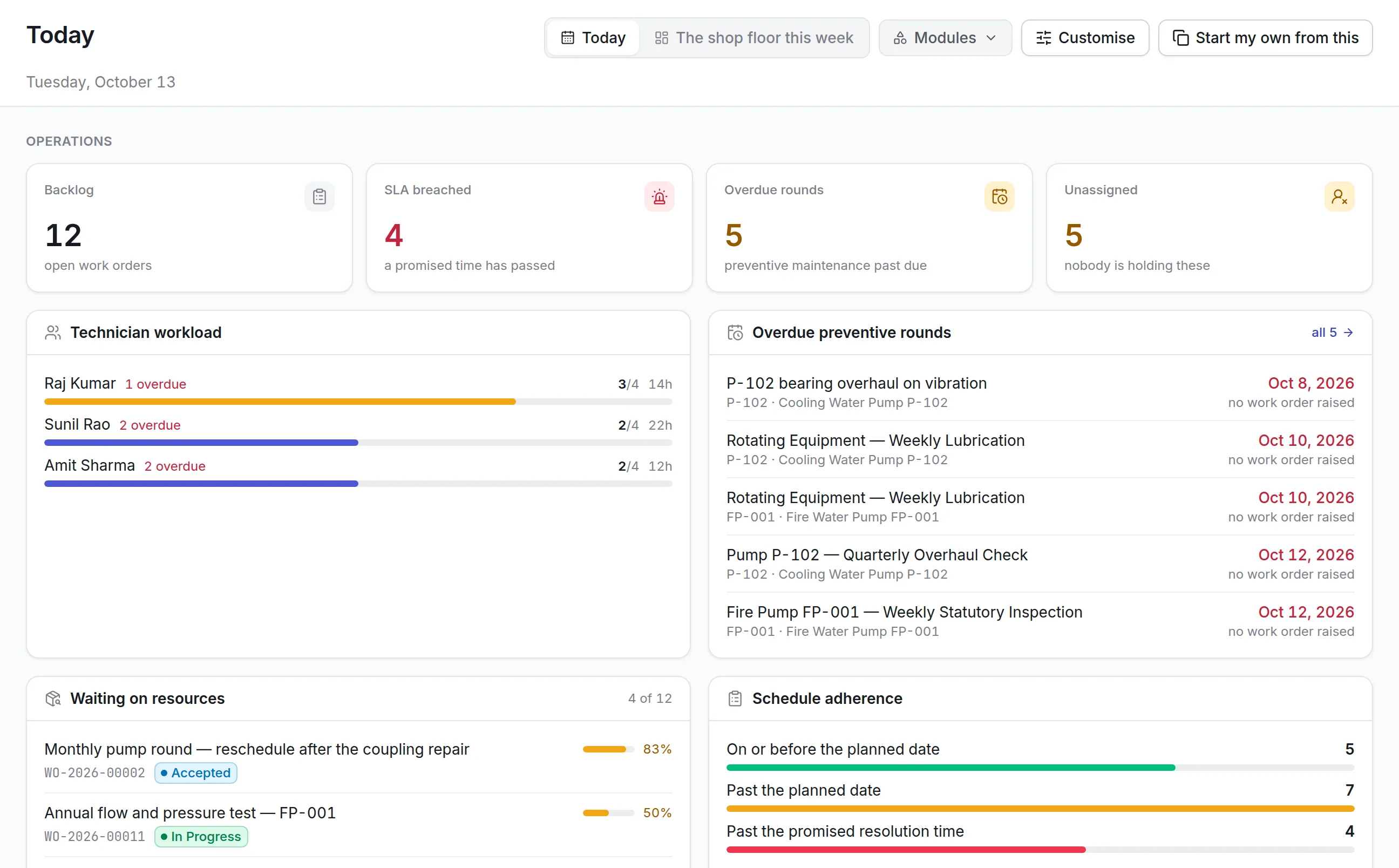
- Plant manager: plans the week’s services. A dashboard shows services due by site, so machines can be serviced between shifts instead of during them.
Before and after
| Before | With Asset Infinity | |
|---|---|---|
| Service timing | Wall charts, intervals missed | Plans driven by engine hours |
| Defects | Found when the machine broke down | Caught at the pre-start check |
| Repairs | Reported late to the plant team | Raised automatically from failed checks |
| History | Left behind at each site | Stays with the machine |
| Schedules | Disrupted by breakdowns | Services fitted around the work |
How it rolled out
- Current practice reviewed. The plant team assessed how services were scheduled and where intervals were missed.
- Fleet and history moved. Machines and past service records were moved in, with plans and site-based workflows for each service type.
- Operators and fitters trained. Operators learned the pre-start checklist; fitters learned to work and close jobs on the mobile app.
The results
- 27% less heavy plant downtime
- Every machine’s next service is visible to the plant team, by site.
- Fewer missed services and unplanned repair gaps.
- Complete service history kept with each machine across sites.
- Fewer project delays caused by broken-down equipment.
Why it worked
Service on actual use
Hour-based plans fit machines that work hard on one project and sit idle on another.
Operators spot problems first
The person on the machine every morning is the first to see a leak or a fault, and now it is recorded.
One plant team view
The central team sees every site’s machines, so fitters go where downtime would cost most.
Looking ahead
By servicing machines on hours actually run and catching defects at the start of each shift, the firm reduced heavy plant downtime by 27% and kept crews working.
The service history now kept with each machine also helps the firm decide which units to rebuild, which to replace, and which are ready to move to the next project.