






Power plant maintenance software that keeps every unit ready to run
Our power plant maintenance software plans turbine inspections by fired hours and starts, and fits outage work into the window you have. Every isolation is on a permit, and every trip ends in a root cause.
- OSHA 29 CFR 1910.269 (electric power generation, transmission and distribution)
- OSHA 29 CFR 1910.147 (lockout/tagout)
- NERC PRC-005 (protection system maintenance)
- NFPA 70B (electrical equipment maintenance)
What our power plant maintenance software does for a generation team
Inspections by fired hours
Turbine borescopes and combustion inspections fall due on fired hours or starts read from a meter. Breaker tests, oil sampling and diesel load tests run on the calendar.
Outages that fit the window
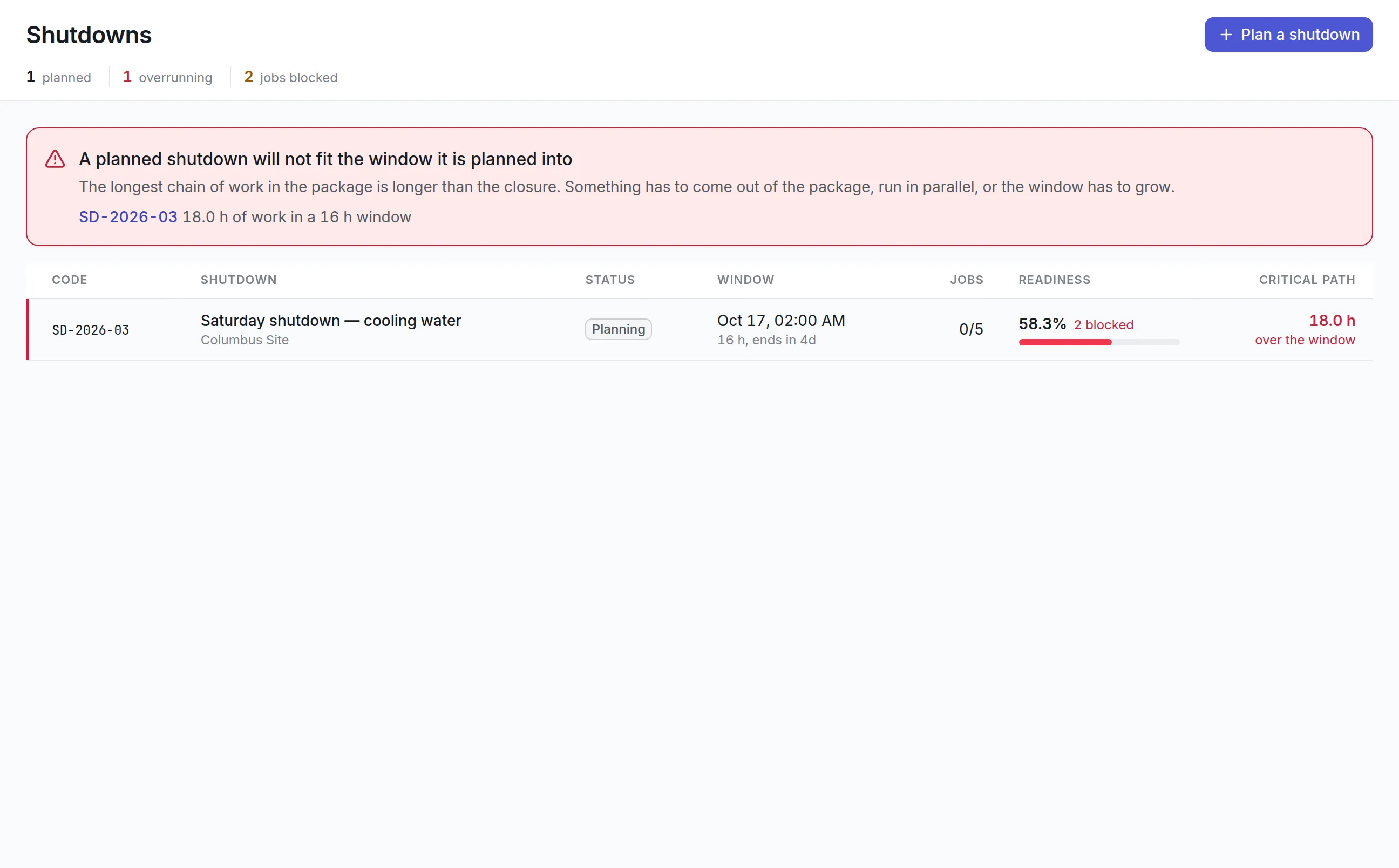
An outage holds its work package, windows, milestones and critical path. Readiness shows which parts, permits and people are still missing weeks before the unit comes down.
Isolation before anyone touches it
Permits for HV switching, lockout, confined space, work at height and hot work record each isolation and who signed it. A job that needs a permit cannot start without one.
Every trip investigated
Breakdowns close with a failure mode, cause and mechanism. Five-whys root cause analysis holds the evidence and checks that each action worked.
Condition data that raises work
Sensors and meters carry temperatures, pressures, vibration and energy exported. A reading past its limit raises an alert, and a condition plan raises the job.
Walk-downs on the phone
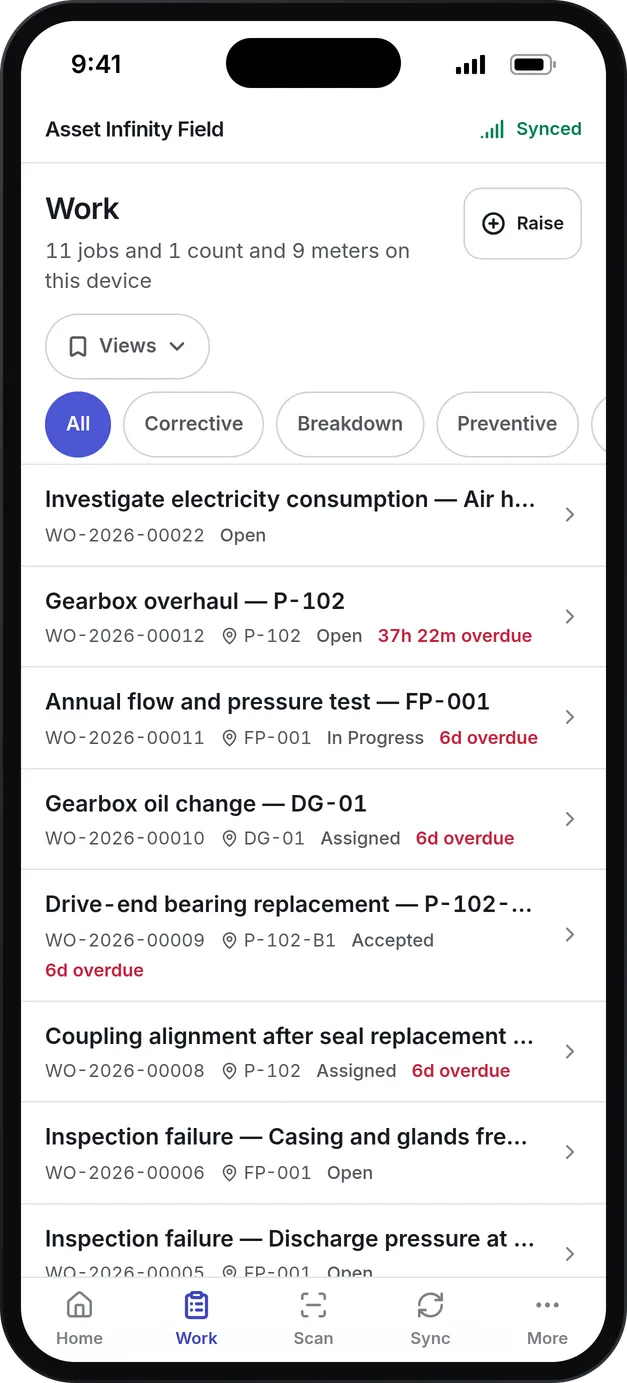
Plant rounds, switchyard walk-downs and inverter checks are graded on the mobile app, offline if need be. A failed critical item raises its own corrective job.
What is power plant maintenance software?
Power plant maintenance software is a system that plans, records and controls the maintenance of generating equipment: gas and steam turbines, generators, heat recovery steam generators, feed pumps, step-up transformers, HV breakers, inverters and wind turbines. It schedules inspections by fired hours and calendar, plans outages, issues permits to work and keeps the history of every trip.
Generators buy it because an hour off the bars costs money and an isolation that is assumed rather than proven costs far more. A station manager wants to know that the borescope is due before the hours run out, that the breaker test happened in the year it was due, and why the gas turbine tripped last month.
How power plant maintenance software works in Asset Infinity
Each station holds its areas, units, switchyard and control room, with every asset in the place it runs. A solar farm or wind farm is a station of its own, so a company with several sites sees them side by side. From the first record to a trip that does not happen again, the work runs like this:
Build the station register
Gas turbines, generators, the HRSG, feed pumps, cooling tower, fuel gas compressor, black-start diesel, transformers and breakers go into the asset register, each with its make, model, serial number and meters.
Put meters on what wears by use
Fired hours and starts on the gas turbine, megawatt-hours exported on the generator, top oil temperature on a transformer, discharge pressure on a compressor.
Load the plans
Borescope inspections every 4,000 fired hours, combustion inspections at 12,000, annual breaker timing tests, monthly black-start diesel load tests and quarterly thermographic surveys. Preventive maintenance software covers the triggers and lead times.
Walk the plant
Operators and technicians grade daily plant rounds and weekly switchyard walk-downs on their phones. A failed critical item raises a corrective job on that asset.
Isolate under a permit
HV switching, lockout, confined space, work at height and hot work permits record each isolation, and a job that needs one cannot start without it.
Close with a failure code, then find the cause
A trip closes with its failure mode, cause and mechanism, and a repeat fault or a major trip opens a root cause investigation.
Outages planned around the window you have
The big inspections happen in outages, and an outage has a fixed number of hours. Shutdown planning holds the work package, the windows inside the outage (cool-down, hot gas path open, restart and testing), the milestones before it (scope frozen, spares on site, permits issued) and the isolations each asset needs.
The product answers two questions weeks ahead of the unit coming off line: will the work fit, and is it ready. The critical path is the longest chain of work in the package. When it is longer than the window, the shutdowns register says so and by how many hours. Readiness counts the jobs whose parts, permits, tools, skills and vendors are in hand, and names the ones blocked. A combustion inspection whose liners are on a ten-week lead time shows as blocked long before anyone is waiting on a truck.
More detail
Corrective jobs that need the unit off line, such as drifting exhaust thermocouples or a tap changer service, can be pulled into the same work package, so the outage takes them with it rather than costing another stop.
HV switching and lockout permits in power plant maintenance software
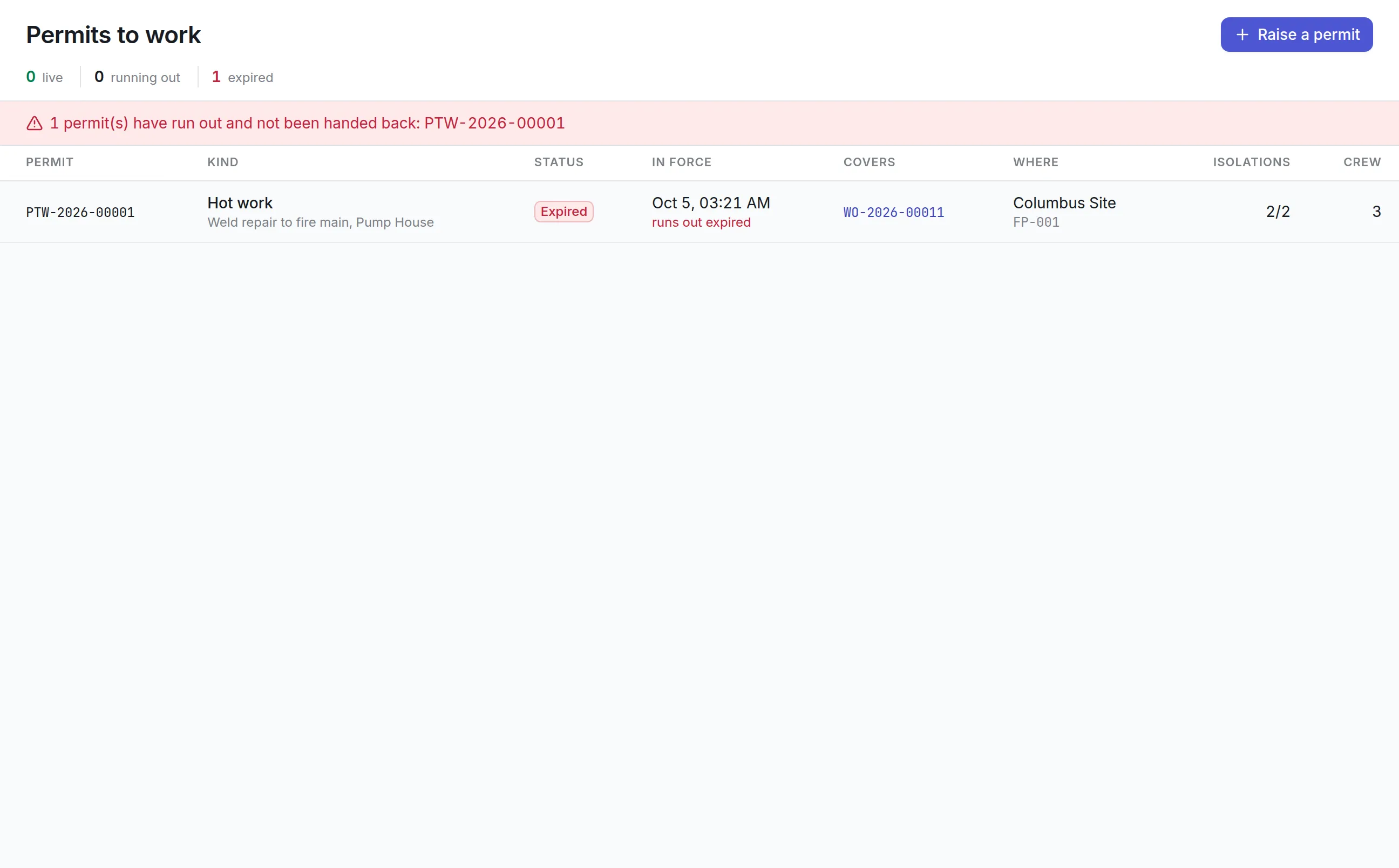
Nothing in a switchyard or a turbine enclosure is touched without an isolation. A permit to work in Asset Infinity holds the hazards, each isolation with its method (lock, ground, valve, spade) and its lock reference, the precautions with their measured values, such as proved dead at 0 kV, and the crew, including contractor staff by name and company.
- Permit kinds include electrical, lockout/tagout, confined space, work at height and hot work
- A permit can cover a single work order or a whole outage, so every job in it is covered
- A work order that needs a permit cannot move to in progress until a live one covers it
- Permits running out, expired or not handed back are counted at the top of the register
- A permit cancelled because the job did not need it keeps its reason on record
More detail
Lockout tagout software explains the permit life cycle in more detail. The records are what an OSHA 1910.269 or 1910.147 audit looks for. Asset Infinity keeps the records; it does not certify compliance.
Condition monitoring and sensors
The control system already knows a turbine’s run hours, a bearing’s vibration and a transformer’s top oil temperature. Sensors bring that into the maintenance record, where a reading can do something.
More detail
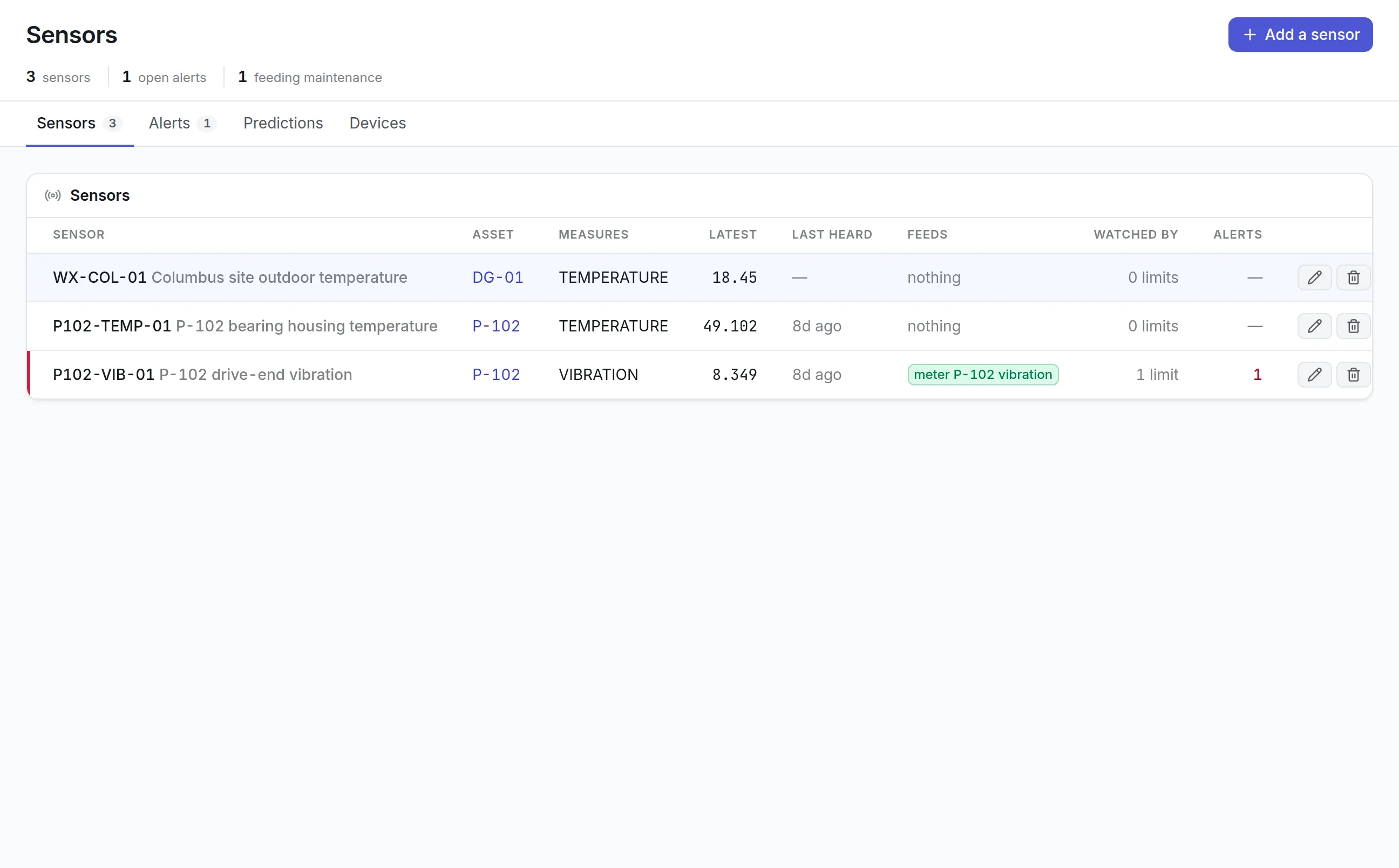
Each sensor belongs to an asset and says what it measures. A sensor can feed a meter, so fired hours or starts written by the control system move the plan without anyone typing a reading. A limit on a sensor raises an alert when a reading crosses it, and a plan with a condition trigger raises the job, once, until that job is finished. A steam turbine bearing whose vibration keeps rising becomes a predictive work order with its readings attached. Predictive maintenance software covers how sensors, limits and alerts fit together.
Energy management records the megawatt-hours each unit and inverter exports, so output sits on the same record as the work that kept it running. Energy management software has the detail.
Root cause analysis for every unit trip
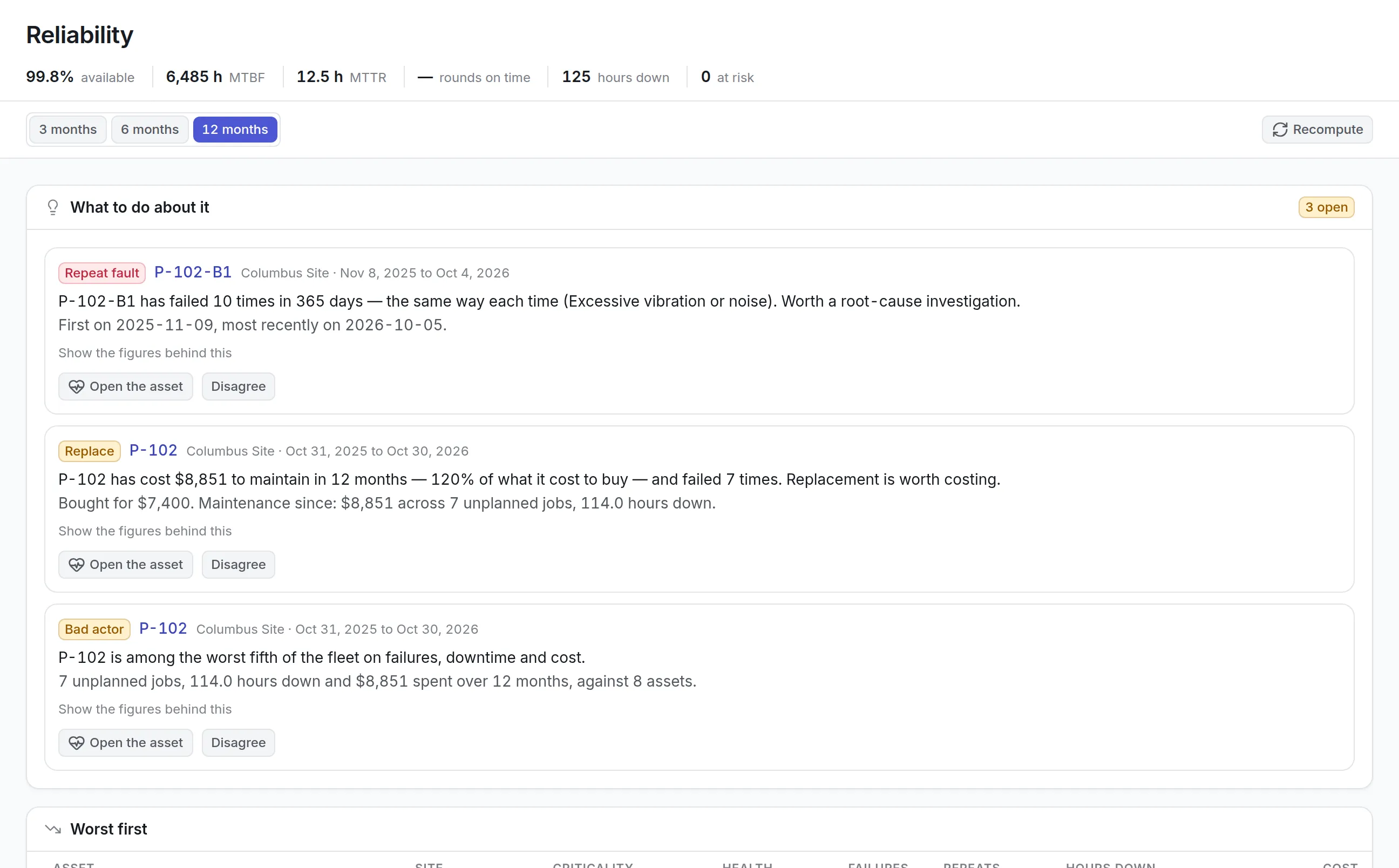
A unit trip is investigated, not just reset. Breakdowns close with the product’s failure vocabulary, and the Reliability screen turns that history into availability, MTBF and MTTR for every asset, with recommendations a reliability engineer can agree with or dismiss.
More detail
With root cause analysis software a trip on exhaust temperature spread becomes an investigation: each why with its evidence (a DCS trend, a borescope finding, a filter differential pressure), the root cause, and corrective and preventive actions. Each action is verified, then reviewed for whether it worked, so a fix that did not hold shows up rather than being forgotten.
What should you look for when choosing power plant maintenance software?
A generation site needs more than a list of work orders. Compare products on the things that keep units available and crews safe.
- Meter-based plansTurbines are inspected by fired hours and starts, not the calendarIn Asset InfinityPlans fall due on run hours, cycles or calendar
- Outage planningInspections must fit a fixed windowIn Asset InfinityWork packages, windows, milestones, readiness and critical path
- Permits to workIsolation has to be proven and signedIn Asset InfinityElectrical, lockout, confined space, height and hot work permits with a hard stop on the job
- Failure codesTrip history needs something to group byIn Asset InfinityFailure mode, cause, mechanism, severity and how it was detected
- Root cause analysisA repeat trip costs more than the first oneIn Asset InfinityFive-whys investigations with verified, reviewed actions
- Sensors and condition triggersCondition data should raise work by itselfIn Asset InfinitySensor limits raise alerts and feed meters that trigger plans
- Inspections and walk-downsHot spots and leaks are found on roundsIn Asset InfinityGraded checklists with critical items that raise corrective jobs
- Service contractsLong-term service agreements and O&M contracts set response timesIn Asset InfinityContracts with covered assets, scope and response and fix times
- Spare partsA missing seal cartridge keeps a pump out of serviceIn Asset InfinityStock by storeroom, reorder points and purchase requests
- Offline mobile appSwitchyards and remote farms have poor signalIn Asset InfinityiOS and Android app that syncs when back in range
See it on your own assets, or price it in two minutes.
Power plant maintenance software by site type
Each site starts from the same product and switches on what its work needs.
Gas-fired and combined-cycle stations
The gas turbine carries fired hours and starts, and its borescope and combustion inspections fall due on them. Feed pumps, the cooling tower and the black-start diesel run on monthly plans, the long-term service agreement is a contract on the turbine and generator, and each major inspection is an outage with its own work package and permits.
Solar farms
Inverters, PV arrays, string combiner boxes, trackers and the weather station are assets on the array block they sit in. Quarterly inverter services and monthly panel cleaning are plans, monthly inverter checks are graded on the phone, and the O&M contractor’s response times sit on the contract that covers the farm.
Wind farms
Each turbine is an asset at its own position, with its faults and services on its record. Climbs are work at height permits with the wind speed at hub height recorded as a precaution, and a contractor climber can be named on the crew.
Switchyards and substations
Step-up transformers and HV breakers carry annual timing tests, oil sampling and dissolved gas analysis, and quarterly thermographic surveys. A weekly walk-down that finds a hot clamp raises the repair on the breaker, and the repair runs under an electrical permit with its grounds recorded. Teams running water and wastewater plants have their own page at water and utilities.
What power plant maintenance software costs with Asset Infinity
The asset register starts at $130 a month for up to 500 assets, with unlimited users. Maintenance is $25 per user per month and parts and stock is $20 per user per month. The add-ons a generation site uses most are flat per organization:
- Reliability and root cause, $150 a month
- Energy and utilities, $150 a month
- Permits to work, $100 a month
- Contracts, $100 a month
- Reordering, $75 a month
Sensors and gateways come from the Asset Infinity store. Build a quote for your own stations.
The power generation trial opens with a combined-cycle gas turbine station, a solar farm and a wind farm already loaded, with “Site” renamed “Station”. It includes gas and steam turbines, the HRSG, feed pumps, step-up transformers, 132 kV breakers, central inverters and two wind turbines, plus a borescope plan on fired hours, an annual breaker timing test, a monthly black-start diesel load test, an outage being planned, open permits and a gas turbine trip already traced to its root cause. The rename can be changed back on the Localization screen.
Getting started at one station
Most generators start with one station and its switchyard:
- Import the assets for the power block and switchyard, and print asset labels.
- Add meters for fired hours and starts, and load the plans that run on them.
- Raise permits for HV switching and lockout on the jobs that need them.
- Plan the next outage as a shutdown and watch readiness build.
Then add the solar and wind sites. If you want to see it with your own equipment first, book a demo.
What teams in this industry use most
Common questions
What is power plant maintenance software?
Power plant maintenance software plans and records the maintenance of generating equipment such as turbines, generators, transformers, breakers, inverters and wind turbines. It schedules inspections by run hours and calendar, plans outages, controls permits to work and keeps the history of every trip and repair.
Can maintenance be scheduled by fired hours or starts?
Yes. A meter on a turbine holds its fired hours or starts, and a plan falls due when the reading reaches its interval. Readings can be typed on the phone or written through by sensors.
Does it plan outages?
Yes. An outage is planned as a shutdown with its windows, milestones and work package. The product works out the critical path and warns when the work will not fit the window.
Does it handle HV switching and lockout permits?
Yes. A permit to work lists each isolation, its method and reference, the precautions and the crew. A work order that needs a permit cannot move to in progress until a live permit covers it.
Does it help with NERC and OSHA records?
It keeps dated work records, test readings, inspection results and permit histories that an auditor asks to see. Asset Infinity keeps the records; it does not certify compliance with NERC or OSHA.
Does it work for solar and wind sites?
Yes. Solar farms and wind farms are sites of their own, with inverters, trackers, combiner boxes and turbines as assets, quarterly inverter services, panel cleaning and climb permits for turbine work.
See it with your own assets
A demo run on an example from your industry. Or start the trial and look around on your own.