


In this article
- What Is Accumulated Depreciation?
- Is Accumulated Depreciation Classified as an Asset or Liability?
- Where Does Accumulated Depreciation Appear on Financial Statements?
- Why Is Accumulated Depreciation Important in Accounting?
- Common Misconceptions About Accumulated Depreciation
- So, Is Accumulated Depreciation an Asset or a Liability?
- Frequently Asked Questions
Accumulated depreciation is not a liability, and it is not an asset in its own right. It is a contra-asset account with a credit balance. It sits in the assets section of the balance sheet, under property, plant and equipment, and reduces the cost of the assets it belongs to. Cost minus accumulated depreciation is the asset’s net book value.
This guide explains what accumulated depreciation is, how it is classified, where it goes on the balance sheet, the journal entry that records it, and the misunderstandings that trip people up. To see how annual figures build up under US tax rules, try the MACRS depreciation calculator.
What Is Accumulated Depreciation?
Accumulated depreciation is the total depreciation expense recorded against a fixed asset since it was put into service. It is a running total that grows each time depreciation is recorded, usually every month or every year, until the asset is fully depreciated or leaves the business.
When an organization buys a fixed asset, such as machinery, a vehicle or IT equipment, the cost is capitalized on the balance sheet. Over time the asset wears out, becomes obsolete or is used up. Depreciation spreads the asset’s cost over the years it is used, and accumulated depreciation keeps the total charged so far.
There are several ways to calculate depreciation. One of the most common is straight-line depreciation, where the same amount is charged each year over the asset’s useful life.
For example, a company buys a machine for $10,000 with a useful life of 5 years and no salvage value. Annual depreciation is $2,000. After three years, accumulated depreciation is $6,000 and the machine’s net book value is $4,000.
Is Accumulated Depreciation Classified as an Asset or Liability?
This question confuses even experienced professionals.
The simple answer: accumulated depreciation is neither an asset nor a liability. It is a contra-asset.
A contra-asset is an account that offsets a related asset account. Accumulated depreciation reduces the book value of the fixed asset it relates to. It appears in the asset section of the balance sheet, but it carries a credit balance, the opposite of the normal debit balance of an asset.
It is not a liability because it is not money the business owes to anyone. No one will ever be paid the balance in accumulated depreciation. It only records how much of the asset’s cost has already been charged as an expense.
The distinction matters. Accumulated depreciation does not reduce cash or add to what the company owes, but it does lower the net book value of its assets, which changes how the company’s financial position reads.
The related question “is depreciation an asset or a liability?” has a different answer. Depreciation expense is neither: it is an expense, reported on the income statement for the period. Accumulated depreciation is the balance-sheet total of all those expenses to date.
For more on why the running total is worth tracking, read our guide to fixed asset accounting software.
Where Does Accumulated Depreciation Appear on Financial Statements?
Accumulated depreciation goes on the balance sheet, in the assets section under property, plant and equipment. It is usually listed directly below the fixed asset line it relates to, shown as a negative figure, with the net book value beneath it.
Here is an accumulated depreciation example in balance sheet format:
| Property, plant and equipment | Amount |
|---|---|
| Machinery, at cost | $100,000 |
| Less: accumulated depreciation | ($40,000) |
| Machinery, net book value | $60,000 |
Many companies show several classes this way, or show one net figure on the face of the balance sheet and the cost and accumulated depreciation by class in the notes:
| Property, plant and equipment | Cost | Accumulated depreciation | Net book value |
|---|---|---|---|
| Buildings | $500,000 | ($120,000) | $380,000 |
| Machinery | $100,000 | ($40,000) | $60,000 |
| Vehicles | $75,000 | ($45,000) | $30,000 |
| Total | $675,000 | ($205,000) | $470,000 |
Land is not depreciated, so it has no accumulated depreciation.
This presentation shows both the original cost of the assets and how much of that cost has been charged as depreciation so far.
The depreciation expense for each period appears on the income statement, where it reduces reported profit. It does not appear there as accumulated depreciation; only the current period’s charge does.
The journal entry that records it
Each period, depreciation is recorded with one entry. For the $10,000 machine above, the yearly entry is:
| Account | Debit | Credit |
|---|---|---|
| Depreciation expense | $2,000 | |
| Accumulated depreciation, machinery | $2,000 |
The debit goes to the income statement. The credit adds to the contra-asset on the balance sheet. The machinery account itself stays at its $10,000 cost for as long as the business owns the machine.
When the machine is sold or scrapped, both its cost and its accumulated depreciation are removed. If it is sold for $3,000 after three years (net book value $4,000), the entry is:
| Account | Debit | Credit |
|---|---|---|
| Cash | $3,000 | |
| Accumulated depreciation, machinery | $6,000 | |
| Loss on disposal | $1,000 | |
| Machinery | $10,000 |
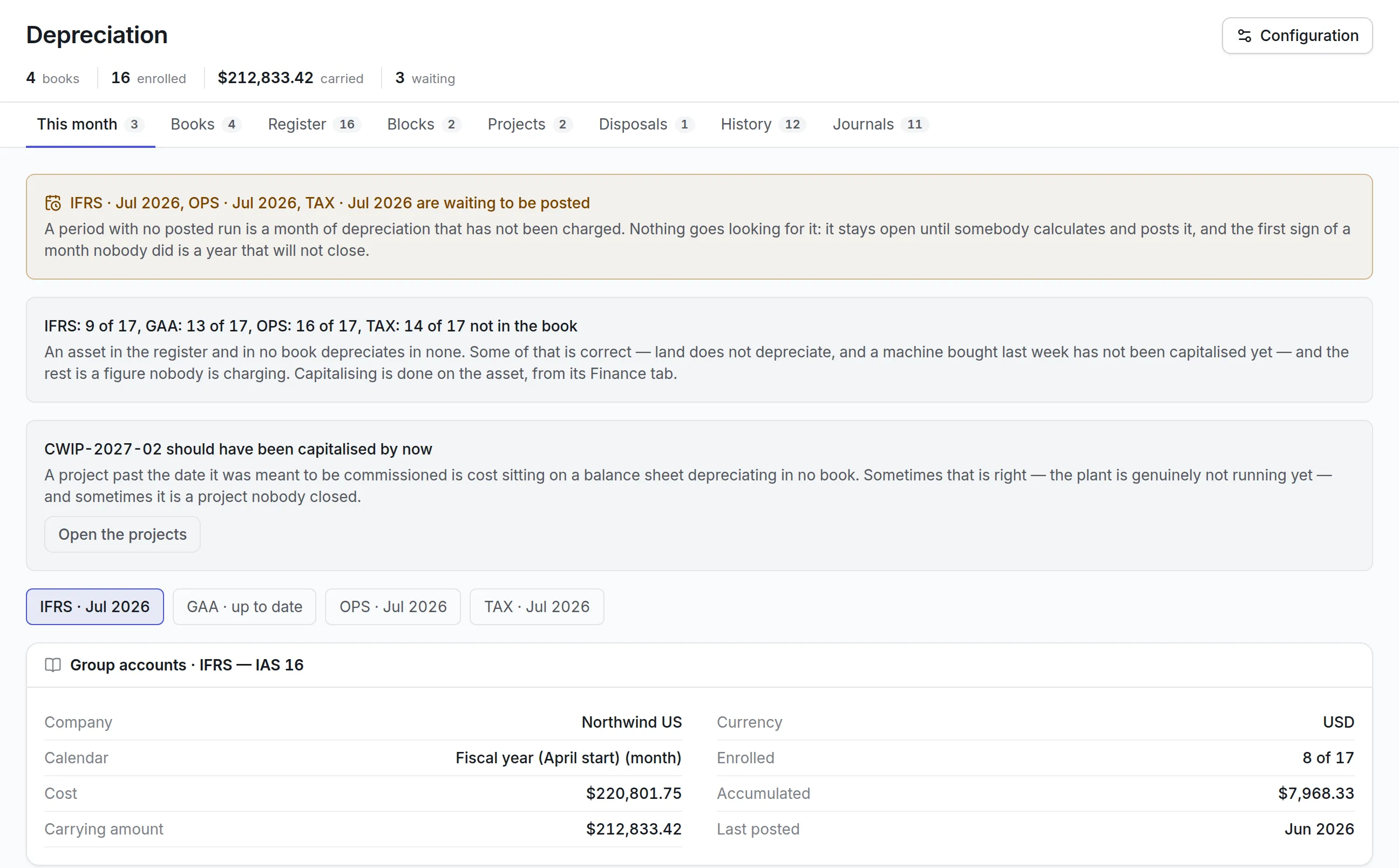
In Asset Infinity, fixed asset management software calculates each period’s depreciation from the schedule, posts it, and exports the journal to your general ledger. Disposals record the sale price and the gain or loss in each book.
Why Is Accumulated Depreciation Important in Accounting?
Depreciation, and accumulated depreciation with it, matters in several parts of accounting and financial reporting.
1. Accurate Asset Valuation
Without proper tracking of assets and depreciation, a company may report asset values that are too high, and its financial statements will mislead readers.
2. Expense Recognition
Depreciation spreads the asset’s cost across its useful life, matching the expense to the periods in which the asset helps earn revenue. This is the matching principle in accounting.
3. Tax Deductions
Depreciation is a non-cash expense that reduces taxable income. In the US, tax depreciation follows IRS rules such as MACRS, set out in IRS Publication 946, which often differ from the depreciation in the financial statements, so many businesses keep a separate tax schedule.
4. Investment Planning
Knowing the accumulated depreciation amount helps a company judge when to replace assets, how much to budget for capital expenditure, and how much of each asset’s cost is left to depreciate.
5. Maintenance and Asset Lifecycle Management
A heavily depreciated asset is usually an old one. Reading accumulated depreciation alongside the asset’s maintenance history and condition helps decide whether to repair it, keep it running or replace it.
Common Misconceptions About Accumulated Depreciation
Here are the misunderstandings that come up most often.
Misconception 1: Accumulated depreciation is a liability
It is a contra-asset, not a liability. It reduces the value of an asset, but it is not money owed to anyone.
Misconception 2: Accumulated depreciation reduces cash flow
Depreciation reduces profit on the income statement, but it is a non-cash expense. The cash left the business when the asset was bought. Recording depreciation moves no cash, which is why it is added back in the operating section of the cash flow statement.
Misconception 3: Accumulated depreciation is optional
US GAAP and IFRS (under IAS 16) both require depreciation on fixed assets other than land. Leaving it out overstates assets and profit.
Misconception 4: Accumulated depreciation shows what an asset is worth
Net book value is cost minus the depreciation charged so far. It is an accounting figure, not a market value. A fully depreciated machine can still be in daily use and worth selling.
So, Is Accumulated Depreciation an Asset or a Liability?
Neither. Accumulated depreciation is a contra-asset: a credit-balance account in the assets section of the balance sheet that offsets the cost of fixed assets. It does not fall neatly into either category, but it is central to accurate financial reporting, tax planning and asset decisions.
Keeping it right depends on a register that knows every asset’s cost, in-service date, useful life and method. The asset register holds those records, and how to prepare a fixed asset register walks through building one. Depreciation in Asset Infinity supports straight-line, declining balance, units of production and rate tables such as MACRS, and an asset can carry more than one book, so the financial statements and the tax return each get their own figures.
Whether you use straight-line depreciation, manage several asset classes or prepare year-end reports, getting accumulated depreciation right is a basic part of sound financial records.
Frequently Asked Questions
What happens to accumulated depreciation when an asset is sold or disposed of?
Both the asset’s original cost and its accumulated depreciation are removed from the balance sheet. The difference between the sale price and the net book value is the gain or loss on disposal. Asset Infinity records disposals with their reason, sale price and gain or loss in each book.
Does accumulated depreciation affect the cash flow of a company?
Not directly. Depreciation is a non-cash expense: it reduces accounting profit but moves no cash. It can affect cash indirectly, because tax depreciation lowers taxable income and therefore tax payments.
Is accumulated depreciation a debit or a credit?
A credit. As a contra-asset, accumulated depreciation has a credit balance that grows each period, while the asset account it offsets keeps its debit balance at cost.
Is accumulated depreciation a current or non-current asset?
It belongs with non-current assets. It is presented within property, plant and equipment, directly against the long-term assets it reduces.
Can accumulated depreciation be more than the cost of the asset?
No. Depreciation stops once net book value reaches the salvage value, or zero if there is none, so accumulated depreciation can never exceed cost.