


The client
The client is a large telecommunications company headquartered in Toronto, with warehouses and distributed field teams across North America.
Support requests come in from departments, offices, technical teams and operational locations. They were tracked through emails, spreadsheets, calls and manual coordination.
The challenge
Requests were being received, but there was no structured way to track them. Progress was followed by email and phone, so responses slipped and ownership was often unclear.
- Requests arrived by email, phone and spreadsheet, with no single queue.
- Ownership was unclear once a request was received.
- Responses risked delay, and some requests were missed.
- Little visibility of ticket status for managers or requesters.
- Repeated follow-ups just to check progress.
What they set up in Asset Infinity
The company ran its service requests in Asset Infinity’s Work feature, with tickets created, assigned, prioritized, tracked and closed in one place.
One request queue
Requests are raised from the web, the mobile app or by email, and every one lands in the same queue. (Work)
Categories and priorities
Each request has a category and a priority set to the company’s service needs, which decide who handles it and how fast. (Work)
Assignment and escalation
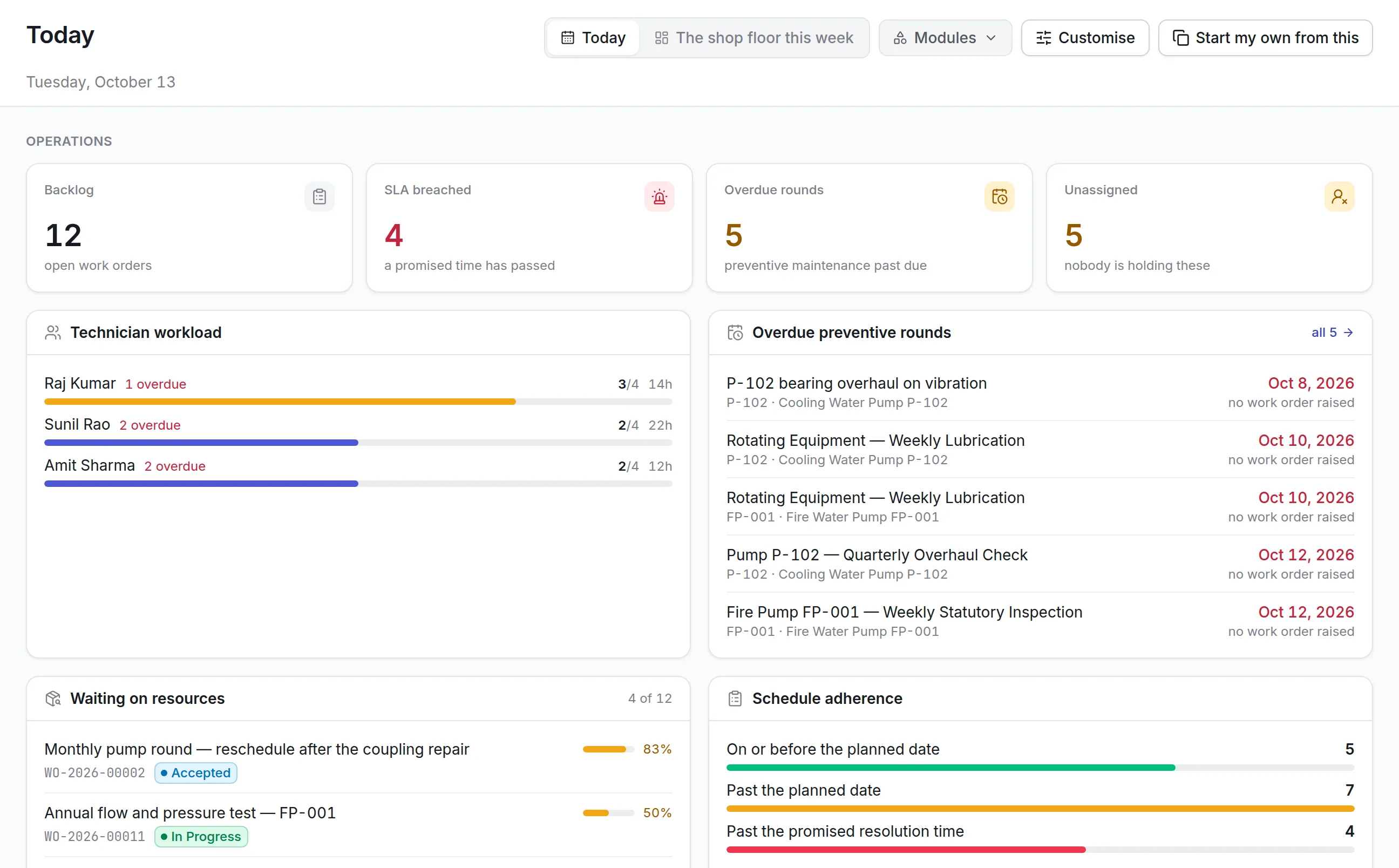
Tickets are assigned to technical, operational or support teams. SLA timers run, and reminders and escalation follow when a ticket waits too long. (Work)
Support performance
Dashboards show open tickets with status, priority and owner, and reports track response and resolution across teams. (Insight)
How it works day to day
Here is what happens now when someone needs support.
- Requester: raises a request. An employee or site raises a request from the web or mobile app, or by email, with a description and any photos.
- System: logs it and starts the clock. The request is logged with its category and priority, and the SLA timer starts.
- Helpdesk coordinator: assigns the ticket. The coordinator turns the request into a work order and assigns it to the right technical, operational or support team.
- Technician: works the ticket. The assignee updates status and notes from the web or mobile app, so the requester can see progress without asking.
- System: escalates delays. If a ticket waits too long, reminders and escalation go out before the SLA is missed.
- Technician: resolves and closes. Once the issue is fixed, the ticket is closed with notes on what was done, building a history for similar requests.
- Support manager: reviews performance. Dashboards show open tickets by priority and team, and reports show how quickly tickets are resolved.
Before and after
| Before | With Asset Infinity | |
|---|---|---|
| Receiving requests | Emails, calls and spreadsheets | One queue from web, mobile and email |
| Ownership | Often unclear | An assigned owner on every ticket |
| Priorities | No structured categories or priorities | Category and priority on each ticket |
| Response | Risk of delays and missed requests | SLA timers, reminders and escalation |
| Status | Checked through repeated follow-ups | Visible to requesters and managers |
How it rolled out
- Assessment. Support channels, ticket volumes, response practices and service gaps were reviewed.
- Categories, assignment and workflow. Ticket categories, priorities, assignment across teams and the steps from creation to closure were configured.
- Teams trained. Support teams were trained, and workflows were refined based on ticket performance.
The results
- All service requests consolidated into one helpdesk.
- Faster resolution through organized assignment.
- Clear status, priority and owner for every ticket.
- Defined responsibility at each stage of a ticket.
- Fewer follow-ups to check on progress.
- Better coordination across service, technical and operational teams.
Why it worked
One front door
Every request, however it arrives, ends up in the same queue, so nothing is lost in an inbox.
Clear ownership
Each ticket has a named owner at every stage, which made accountability simple.
Delays surface early
SLA timers and escalation flag slow tickets while there is still time to act.
Looking ahead
With Asset Infinity, the company moved from fragmented request handling to one helpdesk across its support operations. Teams create, assign, prioritize, track and resolve tickets in the same structured way.
Service visibility is better, manual coordination has dropped, and every ticket has a clear owner from the moment it is raised to the moment it is closed.