


The client
The client operates hundreds of electric two-wheelers, three-wheelers and last-mile delivery vehicles across several city clusters, serving e-commerce, food delivery and on-demand mobility.
Each vehicle completes several duty cycles a day. A vehicle off the road is a missed delivery, so the operator needed reliable fault reporting, root cause analysis and preventive maintenance.
The challenge
Motor, controller and battery faults kept coming back. Service logs were missing or inconsistent, so nobody could see the pattern, and vehicles returned to the service bay with the real problem still unsolved.
- Recurring faults with no consolidated root cause insight.
- Technicians diagnosed the same issue differently at each location.
- No standard checklists for scheduled maintenance.
- No central view of which vehicles failed most often.
- Vehicles repeatedly sent back to the service bay.
What they set up in Asset Infinity
Asset Infinity became the operator’s single record of faults, repairs and fleet health, with preventive maintenance planned for every vehicle type.
Fault reporting from the mobile app
Drivers report faults from the mobile app with a category, description and photos, and the request goes to the right depot’s technicians. (Work)
Standard preventive plans
Checklists for each vehicle type, with plans by odometer, runtime hours or date. Overdue maintenance is escalated. (Maintenance)
Root cause analysis
Repair logs with required fields make faults comparable, so recurring problems such as controller overheating or loose connections are grouped and traced to their cause. (Maintenance)
Spare parts by vehicle and supplier
Parts are issued to each repair, showing which components fail most and which suppliers’ parts keep being replaced. (Stores)
How it works day to day
This is what happens now when a vehicle develops a fault.
- Driver: reports the fault. From the mobile app, or by scanning the QR label on the vehicle, the driver picks a fault category, adds a description and photos.
- System: sends it to the depot. The request reaches the depot responsible for that vehicle, and the assigned technician is notified on the mobile app.
- Technician: logs the repair. Required fields capture the diagnosis, parts replaced and labor, so every repair is recorded the same way at every depot.
- Storekeeper: issues the parts. Parts are issued against the work order, building a record of which components and suppliers are used on each vehicle.
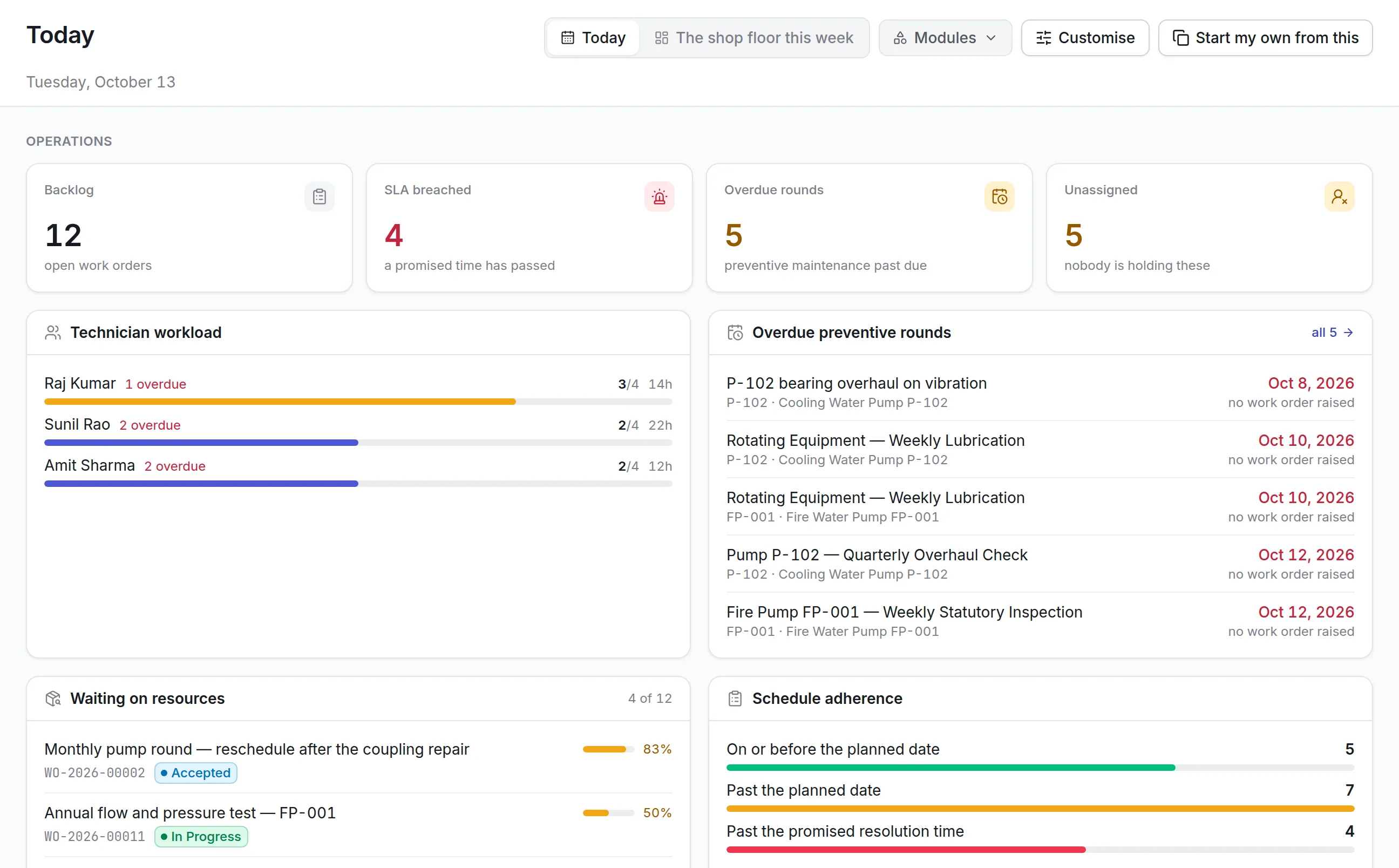
- System: plans preventive work. GPS trackers feed odometer and engine hours into meter-based plans, which create work orders when service is due and escalate when it is overdue.
- Maintenance lead: finds the root cause. Dashboards group recurring faults by depot, technician, vehicle model and vehicle, and the team records a root cause analysis for repeat problems.
Before and after
| Before | With Asset Infinity | |
|---|---|---|
| Fault reporting | Inconsistent or missing | Drivers report from the app with category and photos |
| Repair records | Different at every location | Standard logs with required fields |
| Scheduled maintenance | No standard checklists | Plans by odometer, runtime or date, with escalation |
| Problem vehicles | No central view | Dashboards show vehicles with the most faults |
| Parts | Replaced again and again | Consumption traced by component and supplier |
| Repeated failures | Vehicles sent back to the bay | 67% fewer within 120 days |
How it rolled out
- Phased by depot. The system was rolled out across all depots in phases.
- Hands-on training. Drivers, dispatch leads and depot technicians were trained in hands-on sessions.
- No disruption. Daily routes and deliveries continued as normal throughout the rollout.
The results
- 67% reduction in repeated failures within 120 days
- Better repair quality through standard technician logs.
- Higher fleet availability and fewer mid-route breakdowns.
- Component failure trends that support better supply chain decisions.
- Lower maintenance overheads and fewer repeated part replacements.
- Closer work between operations, maintenance and vendor teams.
Why it worked
Every fault in one place
Drivers, technicians and managers work from the same record, so patterns that were invisible across depots became obvious.
Standard repair logs
Required fields made repairs comparable between locations, which is what root cause analysis depends on.
Rolled out without disruption
A phased rollout with hands-on training kept every route running while the new process took hold.
Looking ahead
By centralizing fault logs, standardizing repair records and planning preventive maintenance, the operator cut repeated vehicle failures by 67% and made its fleet more reliable and predictable.
Every fault and repair now builds a vehicle’s history, so the team can see which models, components and suppliers cause trouble and fix what is really causing the failures.